

The Brain Gain
Can the new to market ExoMind TMS treatment build your mental resilience? Grab your Oura ring and let's find out.

The below article is something I wrote for a recent issue of Harrods Magazine and I wanted to share it here with a little extra commentary because I think it really is a fascinating new frontier in wellbeing and likely you will start reading more and more about it in the press. I have, like many women in their late 30s with a toddler, a full time job and full blown addiction to my phone started to feel the strain on my ability to think sharp and fast. Decreased sleep + increased stress + constant dopamine rollercoaster = decreased cognitive function, that is quite well documented. Perhaps it’s perimenopause, perhaps I am just really really tired but I am partial to loosing my train of thought mid sentence these days. Lots of people thought I was mad to try this treatment - why risk messing with your brain? But the people who knew about TMS, who had read the research, were already on the brain optimisation train or had known someone treated by it successfully, were wildly enthusiastic about it filtering through (albeit in a self-care lite version) to the masses. Let’s dive straight into the feature and I will add a few more notes at the end….
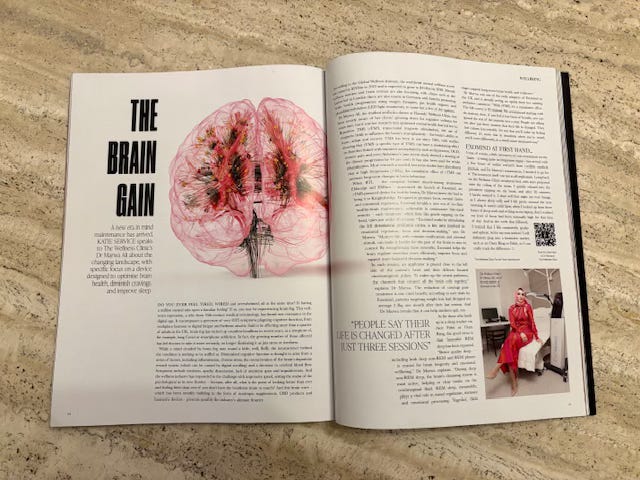
The Brain Gain
A new era in mind maintenance has arrived. KATIE SERVICE speaks to The Wellness Clinic’s Dr Marwa Ali about the changing landscape, with specific focus on a device designed to optimise brain health, diminish cravings and improve sleep.
Do you ever feel tired, wired and overwhelmed, all at the same time? Is having a million mental tabs open a familiar feeling? Welcome to the world of brain fog. This well-worn expression, a relic from 19th-century medical terminology, has found new resonance in the digital age. It encompasses a spectrum of very-2025 symptoms plaguing cognitive function, from workplace burnout to digital fatigue and bedtime anxiety. Said to be affecting more than a quarter of adults in the UK, brain fog has racked up countless headlines in recent years, as a symptom of, for example, long Covid or smartphone addiction. In fact, the growing number of those affected has led doctors to take it more seriously, no longer dismissing it as just stress or tiredness.
While a mind clouded by brain fog may sound a little, well, fluffy, the neuroscience behind the condition is nothing to be sniffed at. Diminished cognitive function is thought to arise from a series of factors, including inflammation, chronic stress, the overactivation of the brain’s dopamine reward system (which can be caused by digital scrolling) and a decrease in cerebral blood flow. Symptoms include tiredness, apathy, dissociation, lack of attention span and impulsiveness. And the wellness industry has responded to the challenge with impressive speed, setting the realm of the psychological as its new frontier – because, after all, what is the point of looking better than ever and feeling fitter than ever if you don’t have the healthiest brain to match? And this brain wave – which has been steadily building in the form of nootropic supplements, CBD products and biometric devices – presents possibly the industry’s ultimate frontier.
According to the Global Wellness Institute, the worldwide mental wellness sector was valued at $233bn in 2023 and is expected to grow to $414bn by 2028. Mental wellness tourism and brain retreats are also booming, with clinics such as the Lanserhof in London (there are also resorts in Germany and Austria) promoting brain health programmes using oxygen therapies, gut health regimes and photobiomodulation (LED light treatments), to name but a few of the options.
Dr Marwa Ali, the resident aesthetics doctor at Harrods’ Wellness Clinic, has been acutely aware of her clients’ growing desire for cognitive wellness for some time, but it was her research into optimised mental health that led her to Repetitive TMS (rTMS, transcranial magnetic stimulation), the use of magnetic fields to influence the brain’s neuroplasticity – the brain’s ability to learn, adapt and recover. TMS has been in use since 1985, with studies showing that rTMS (a specific type of TMS) can have a modulating effect on disorders linked with impaired neuroplasticity such as depression, OCD, chronic pain and even Alzheimer’s (one recent study showed a slowing of the disease progression by 44 per cent). It has also been used for stroke rehabilitation. More research is needed, but some studies have also shown that at high frequencies (>3Hz), the cumulative effect of rTMS can promote long-term changes in brain behaviour.
When BTL – the company behind muscle-toning treatments EMsculpt and EMface – announced the launch of Exomind, an rTMS-powered device for healthy brains, Dr Marwa knew she had to bring it to Knightsbridge. Designed to promote focus, mental clarity and emotional regulation, Exomind heralds a new era of in-clinic healthy-brain maintenance, achievable in noninvasive bite-sized sessions – each treatment, which feels like gentle tapping on the head, takes just under 30 minutes. “Exomind works by stimulating the left dorsolateral prefrontal cortex, a key area involved in emotional regulation, focus and decision-making,” says Dr Marwa. “Modern life, with constant notifications and external stimuli, can make it harder for this part of the brain to stay in control. By strengthening these networks, Exomind helps the brain regulate emotions more effectively, improve focus and support more balanced decision-making.”
In each session, an applicator is placed close to the left side of the patient’s head and then delivers focused electromagnetic pulses. “It wakes up the neural pathways, the channels that connect all the brain cells together,” explains Dr Marwa. The reduction of cravings post- treatment is one cited benefit; according to user trials by Exomind, patients targeting weight loss had dropped on average 2.3kg one month after their last session. And Dr Marwa reveals that it can help smokers quit, too.
As for those who hook up to a sleep tracker via their Fitbit or Oura Ring, the good news is that bountiful REM sleep has been reported. “Better quality sleep –including both deep non-REM and REM phases is crucial for brain longevity and emotionalwellbeing,” Dr Marwa explains. “During deep non-REM sleep, the brain’s cleansing system is most active, helping to clear toxins via the cerebrospinal fluid. REM sleep, meanwhile, plays a vital role in mood regulation, memory and emotional processing. Together, these stages support long-term brain health and resilience.”
Dr Marwa was one of the early adopters of Exomind in the UK and is already seeing an uptick from her existing aesthetics customers. “With rTMS, it’s a cumulative effect. The full course is 30 sessions. We recommend starting with six sessions; then, if you feel it has been of benefit, you can spread the rest of the sessions over a year. People are telling me after just three sessions that their life is changed. They feel calmer, less irritable. It’s not that you’ll wake up feeling different; it’s more that in situations when you’re tested, you’ll react differently, in a much more measured way.”
EXOMIND AT FIRST HAND…
I was, of course, a little nervous to try out a treatment on my brain – it being quite an important organ – but armed with a few hours of online research from credible medical journals, and Dr Marwa’s reassurances, I decided to go for it. The treatment itself was not at all unpleasant. Lying back on the Wellness Clinic treatment bed, with stars projected onto the ceiling of the room, I quickly relaxed into the persistent tapping on my head, and after 20 minutes, I barely noticed it. I slept well that night (no real change, as I always sleep well) and I felt pretty normal the next morning. It wasn’t until 3pm, when I looked up from three hours of deep work and writing on my laptop, that I realised my level of focus had been unusually high for that time of day. And in the week that followed, I noticed that I felt consistently sparky and upbeat. As for my next session? I will definitely plug into a biometric tracker,such as an Oura Ring or Fitbit, so I can really track the difference.
UNPUBLISHED END NOTES»
I wrote this article very soon after the treatment and so what I didn't have time to include was that I did go through a challenging period at work straight after the treatment - nothing too bad, I just experienced an intense workload, a role change and a lot of big decisions. Reader, I cruised through it with emotional balance and positivity and I think I made good rational choices. At plenty of times during those weeks I wondered whether my emotional resilience was down to the treatment but there was no way of knowing and because (typical journalist) I didn't have the time or funding to commit to it fully, I can’t say for sure what the full experience would be. Four months later brain fog is quite present again but I guess that is no surprise with my lifestyle. What I would have loved to have seen, had I tried more sessions, was some brain re-wiring that helped me make and stick to some new healthier habits, which is what is promised.
When you think of all the discourse around appetite suppressants drugs, ADHD symptoms and peri-menopausal/menopausal side affects, I can’t help but think this is quite the Rubicon moment in the world of wellbeing. What do you think? Would you try it?
Further reading:
Researchers have received £1.3 million from the Medical Research Council to investigate whether targeting theta brain wave activity could reduce cognitive challenges faced by people with ADHD. https://www.kcl.ac.uk/news/brain-waves-adhd